
What’s Happening Here?
We appreciate your patience and interest as we work to preserve Ayr Mount, Edgewater, and Millford’s gardens, landscapes, structures, interiors, and decorative arts objects for future generations. Here’s a roundup of news and notes from Jenrette Foundation properties to keep you informed of our stewardship and conservation efforts.
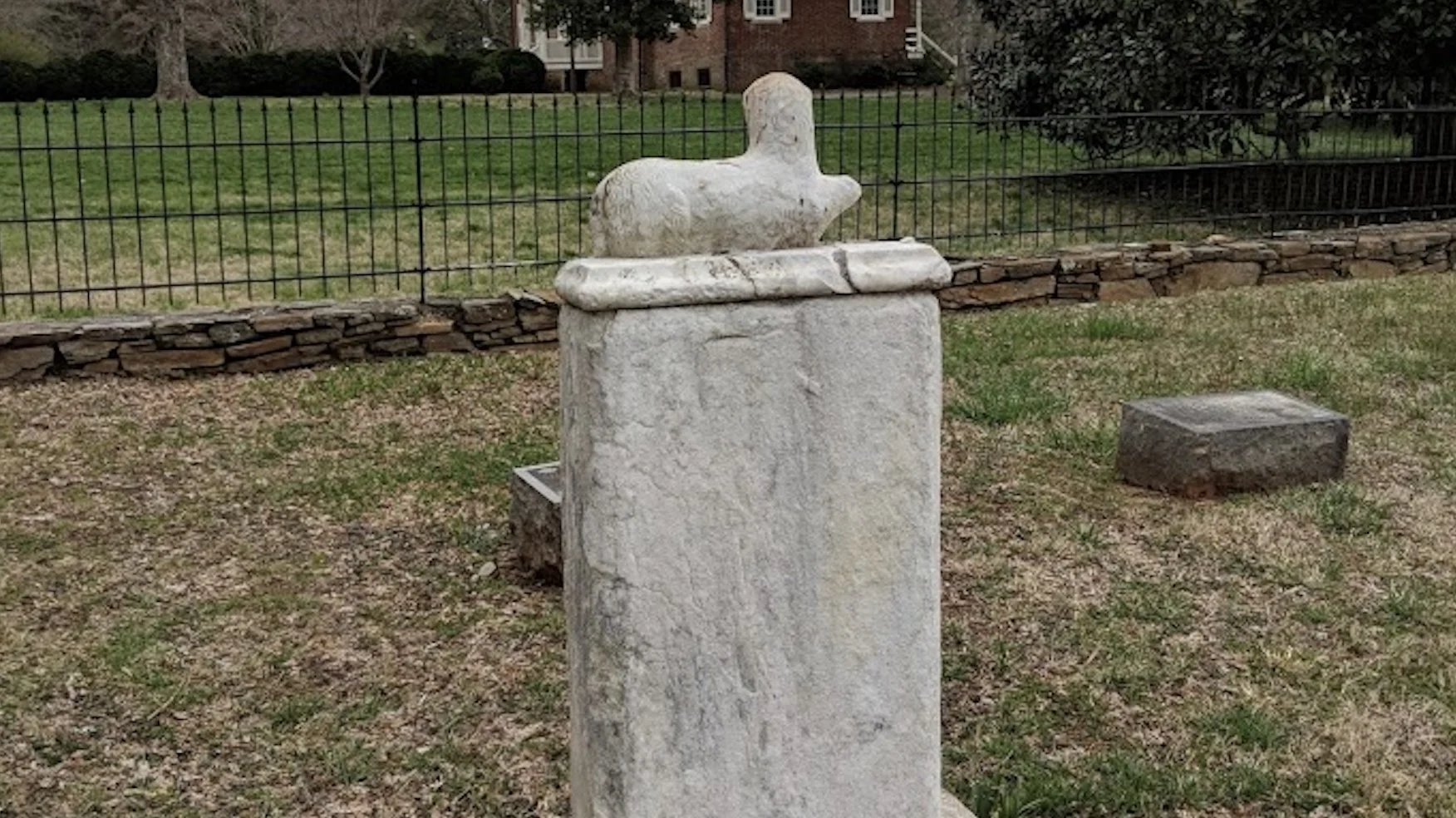
Restoring the Kirkland Family Cemetery Wall at Ayr Mount
The Kirkland Family Cemetery, located on the grounds of Ayr Mount, is a significant historic resource connected to the early history of the estate. Established in the early 19th century, it serves as the final resting place for more than four generations of the Kirkland family, including William Kirkland, who built the house in 1815.
Within a modest enclosed area, the cemetery contains approximately 26 marked and unmarked graves. Among them are the graves of four of Kirkland’s sons, who died in the early 1800s and are buried in unmarked locations. The site reflects both the personal history of the family and broader patterns of burial and memorialization in the period.
The cemetery has long been defined by its enclosing wall, which serves both as a protective boundary and as an important architectural feature of the landscape. Over time, age and environmental factors have led to deterioration of the wall, making restoration necessary.
Current work focuses on stabilizing and rebuilding sections of the wall using appropriate materials and methods. The goal is to preserve the historic character of the cemetery while ensuring its long-term protection.
During this process, visitors may notice construction activity or temporary changes to access near the site. All work is being undertaken with care and respect for the cemetery and those interred there.
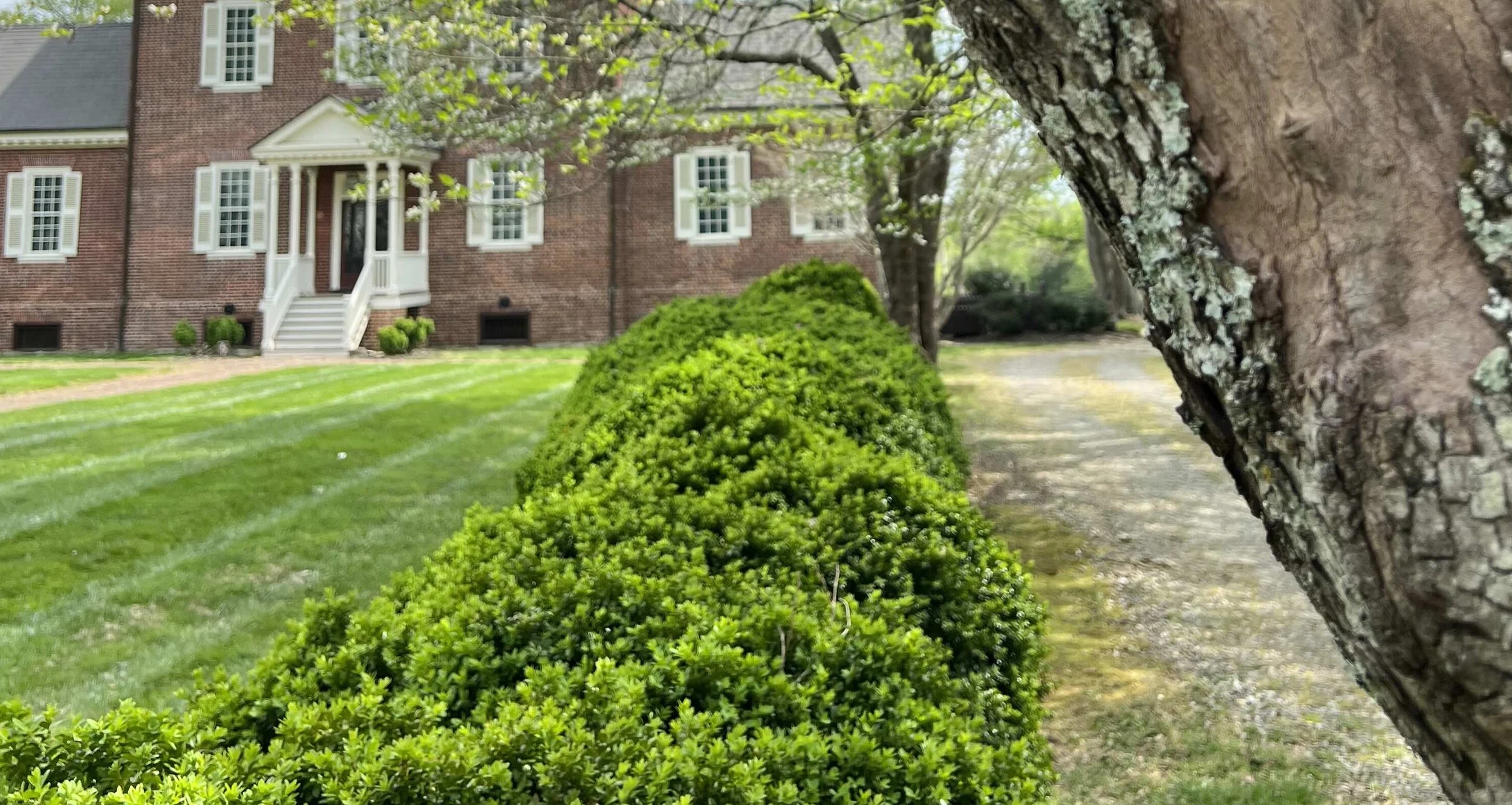
Caring for Ayr Mount’s Historic Boxwood Gardens
The formal boxwood plantings at Ayr Mount are among the defining features of this late 18th-century estate. Designed to complement the Federal-era house and its surrounding landscape, these carefully structured hedges reflect longstanding gardening traditions in the North Carolina Piedmont.
Maintained over generations—including by dedicated long-time gardeners—these boxwoods represent both historic design intent and decades of stewardship. Visitors may notice areas where boxwoods appear thinned, altered, or under treatment with lime. These changes reflect ongoing efforts to steward this historic landscape responsibly. Here’s how:
The North Carolina State University Extension advised us that our boxwoods are infected by nematodes—microscopic worms—that affect the health of the plants. These worms are a natural part of the environment and some varieties are even helpful for plant health. We are following guidance to help rehabilitate the boxwoods through gentle and non-toxic methods, requiring time and patience, as the use of pesticides against nematodes risks harming beneficial organisms and is unlikely to be a long-term remedy. We care about the health and appearance of the boxwoods and other decorative landscaping around the site. Unfortunately, the only way to ensure a pristine appearance for the boxwood hedge is to remove current decades-old plantings entirely and replace them with a variety that is more resistant to these nematodes. Historic stewardship requires a deliberate balance between aesthetics, conservation, feasibility, and cost. We are choosing to take a gentle path to restore the health of the boxwoods in a way that is manageable and responsible to the overall health of the site. We’re choosing progress over perfection.
Edgewater’s New Roof Takes Shape
In 2025, we worked with MCWB Architects at Edgewater to put a new hat on a home that’s graced the Hudson River for more than 200 years. The new standing-seam metal roof will keep everything nice and dry underneath, but that’s just the beginning of the story of what it meant to execute this project under the careful guidance of Jenrette Foundation’s Director of Preservation Will Hamilton and general contractor Mike Pelletier and his team. There’s the structural aspects of the project, sure, but there are hundreds of decorative pieces that needed attention and care including the guttae—tiny circular details that dot the entablature, set in as cones about three-quarters of an inch deep.
If you visited in 2025, you would have seen scaffolding envelop the entire structure—itself an engineering marvel—and you would have seen carefully curated access points for MCWB’s team so they could complete their work without affecting the rest of the structure, which is a lot more than just four outer walls. Preceding the roof in 2024, we replaced the oculus window on the library’s roof with one under the direction of master carpenter Nathanael Ulfers and Avery Toves, assisted by two fine carpentry students from the American College of the Building Arts (ACBA) based on drawings by architectural consultant T.R. Ravella-Hamilton